INDONESIA
‘My parents thought this man would take care of me’
In Indonesia, former child brides push back, seek change.
By Eva Mazrieva | VOA News
KARANG TENGAH, INDONESIAAttending school in her West Java village made Rasminah happy. But when she was 13, her mother said the family could no longer afford tuition or even basic necessities for their oldest daughter and had found her a husband.
Rasminah wept.
“I didn’t protest because I felt sorry for my parents,” says Rasminah, who like many Indonesians uses only one name. “My parents thought this man would take care of me.”
After two years of marriage, on their daughter’s first birthday, he left.
BY THE NUMBERS

INDONESIA
| 14% | 1% |
| Married by 18 | Married by 15 |
A generational decline in the prevalence of child marriage exists in Indonesia, according to UNICEF, with prior levels substantially higher than those today. About 1 in 4 young women had married in childhood around 2000, compared to half around 1980.
| Regional comparison | Married by 18 |
|---|---|
| Laos | 35% |
| Thailand | 23% |
| Timor-Leste | 19% |
| Cambodia | 19% |
| Myanmar | 16% |
| Philippines | 15% |
| Indonesia | 14% |
| Vietnam | 11% |
Select a country to explore how it compares to the region.
Rasminah’s mother found her a second husband. He sent her to work in the local fields where a snakebite to her right leg left it paralyzed. After two years of marriage and a child, he abandoned her.
Her mother selected a third man, whom she married when she was 19 and he was 47. Their marriage produced two children and lasted until his death at 54. She married her fourth and current husband at 26.
Now a decade later, she has five children. Her oldest daughter, who witnessed Rasminah’s struggles as a vulnerable young bride and mother, refused her boyfriend’s marriage proposal when she was 17.
“She told him, ‘My mother is a victim of child marriage. I want to finish my studies and find a great job. I want to have my own income,’” says Rasminah, whose pride in her daughter is palpable. “She understands.”
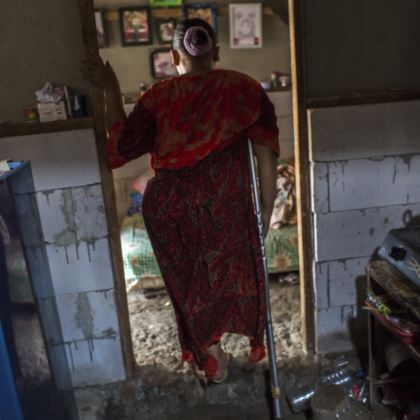
Rasminah was 13 when she was forced to marry. After four husbands and five children, she is now a crusader against child marriage. (Photos by Gembong Nusantara for VOA News)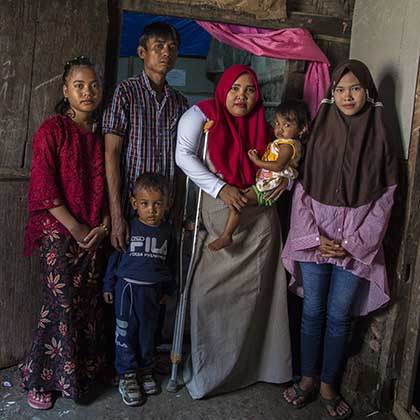
Rasminah, center, and husband Runata, with four of her five children, whose ages range from 2 to 19 years old.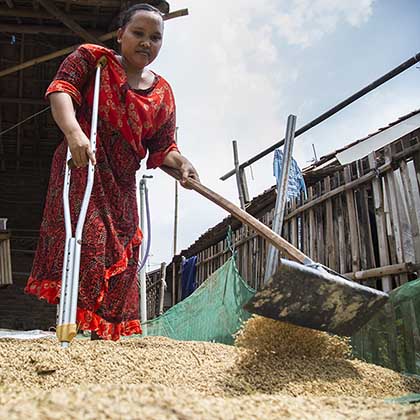
Rasminah steadies herself with a crutch while using a hoe to work in the field. A snakebite on her right leg left it paralyzed.
Crusader
Rasminah’s experiences have transformed her into a crusader against early marriage. In 2018, she and two other women, helped by the Indonesian Coalition to End Child Marriage, pressed the island nation’s highest court to require enforcement of the same minimum legal age for marriage for both sexes.
Though the 1974 marriage law sets 21 as the minimum age, it permits males to marry at 19 and females at 16 with parental consent — and even younger if religious courts or local officials approve a parental request. The Constitutional Court agreed the current law was discriminatory because it limits the constitutional rights of girls to an education and ordered legislators to fix the law within three years.
In Indonesia, 14% of women age 20 to 24 are first married by age 18, according to UNICEF (Globally, 20% of girls marry by 18). The United Nations considers marriage before age 18 a human rights violation, one that threatens girls’ health and education, and limits prospects for them, their families and countries. The U.N. Sustainable Development Goals call for eliminating the practice by 2030.
Complex challenges
Any attempts to end child marriage in Indonesia face knotty cultural, social, legal and religious entanglements that vary by community. Its 269 million people live among 18,000 islands and speak more than 300 languages. It has the world’s largest population of Muslims — more than 209 million — but recognizes five other main religions besides Islam. It has more than 1,000 distinct indigenous groups.
While Indonesia has codified its criminal law, many of its civil laws are based on adat, a legal system based on colonial Dutch law and an indigenous group’s local customs. The minimum age of marriage and concepts of consent differ depending on the adat and where a family lives.
In the border area of East Java and Central Java, where relatives and religious leaders oversee matchmaking, “the collective nature of society” means parents are often “unable to resist the arranged marriage,” Dr. Ida Ruwaida, a sociologist at the University of Indonesia, told VOA.
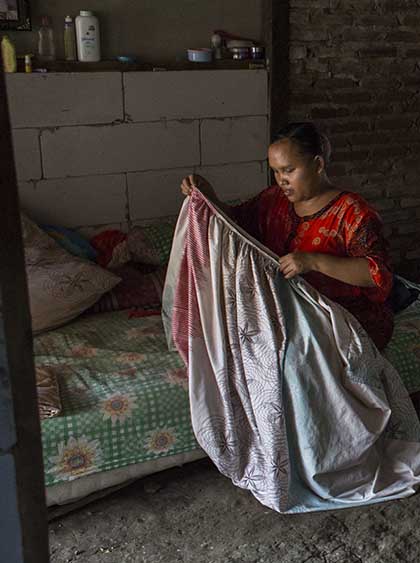
“I didn’t protest because I felt sorry for my parents. My parents thought this man would take care of me.”
Now 36, Rasminah manages the household, while her husband works as a farm laborer.
Among Muslims, marriage before the legal minimum age is widespread. The religious courts issued 13,251 marriage dispensations in 2018, according to Indonesia’s Supreme Court.
Plan International Australia, which works with marginalized children in Indonesia, says more than 90% of applications are granted. UNICEF found that 97 out of every 100 dispensation requests were granted in three districts: Tuban in East Java, Bogor in West Java, and Mamuju in West Sulawesi.
The religious courts often base decisions on the onset of menstruation, which raises the risk of ever-younger brides. The average Indonesian girl’s age at her first period dropped to 13.6 in 2010 from 14.4 four decades earlier, according to government data reported to the U.S. National Institutes of Health. Outside of religious courts, because almost a third of Indonesian children lack birth certificates, adults routinely bribe local officials to falsify birth and marriage documents. By skirting the legal age requirements, they avoid needing a district court’s permission.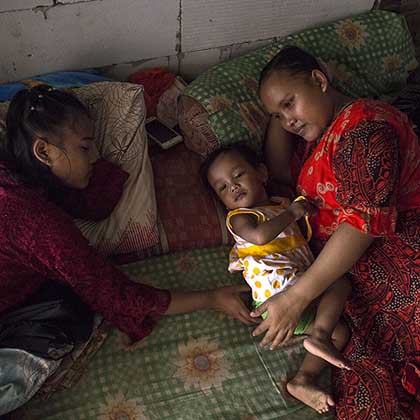
Resting with two of her daughters, Rasminah’s oldest daughter rejected her boyfriend’s marriage proposal at 17.
Pushing back
Some prominent women are taking steps to counter early unions. In 2017, Indonesia’s female Islamic scholars issued a non-binding fatwa against child marriage.
In provinces such as Lombok and Madura, ibu nyai — the influential wives of local clerics who oversee religious boarding schools — intervene when they suspect female students will drop out to marry over holiday breaks.
Lies Marcoes-Natsir, an Indonesian Muslim feminist activist and medical anthropologist, says ibu nyai visit the bride’s parents to explain that more education will improve a girl’s chances for a good job, and that religious schools — unlike public schools — will accept married girls in class.
TRANSLATION: But I think today there’s not too many children who get married as described in the video. People are more educated about the health consequences and the risks of child marriage.
Endang
Indonesia
What do you think? Add your voice to the conversation on Facebook.
The result? Some families might postpone the marriage. Others go ahead with the union but agree to let the girl continue her education, which means more girls continue with school, Lies says.
“The question now is, how much capacity do these leaders have to prevent child marriage? How many children can be protected?”
In 2015, Indonesia’s highest court rejected a petition to review the 1974 marriage law, saying young girls should be allowed to marry to prevent premarital sex and illegitimate babies. But on Dec. 14, 2018, the same court ruled in favor of Rasminah and her colleagues. The Coalition to End Child Marriage argued that by allowing girls to marry at 16, the law violated their constitutional right to education. If the law isn’t revised by December 2021, at a minimum, it must be “harmonized with the 2002 Child Protection Law,” Justice Saldi Isra explained in the court’s decision. That law defines a child as anyone younger than 18, so harmonization would effectively outlaw the minimum marriageable age of 16 for girls.
“This change would matter, because at the community level, the Kantor Urusan Agama (Religious Affairs Office) plays a big role in determining whether the couple can marry or not,” says Aditya Septiansyah, program manager of the Yes I Do project, an anti-child marriage program funded by the Dutch Ministry of Foreign Affairs that works in seven countries, including Indonesia.
“By changing the national level law, they will have reason to reject the application.”
Rasminah’s about-face from acceptance to rejection of local mores may be one of the more effective methods of campaigning against child marriage in Indonesia.
Rasminah, center, along with two other child marriage victims, leaves a hearing on Dec. 13, 2018, after the Constitutional Court ruled that Indonesia’s marriage law violated the rights of girls to an eduation. (VOA News)
Dini Widiastuti, executive director of the NGO Yayasan Plan International Indonesia, says a successful campaign needs local partners who understand an area’s language and cultural nuances. Trained in child protection laws and often given a mandate from village leaders, local activists affiliated with a group like Dini’s can exert pressure with pinpoint accuracy.
“Only people in the community — the clerics, the leaders — can break (through) the cultural beliefs,” she says. People trying to do that from outside a community “would be counterproductive.”
 MegawatiForced to marry at 16
Megawati, who lives in a rural village on Lombok Island, is one of the locals. The 25-year-old credits the nonprofit Kapal Perempuan Institute, or Women’s Ship, for helping her understand how her story could empower others.
She says her family forced her to marry at 16.
“I was mocked for ‘not selling,’” says the now-dogged activist against child marriage. “So, I had to get married or I would become the talk of the village, and that would have been a great shame for the family.”
Her mother chose Megawati’s husband.
“Marriage wasn’t as beautiful as it had been described to me,” Megawati says.
She missed school and resented the fighting about money and interfering in-laws that began soon after the wedding. Then her husband started beating her. The conflicts subsided as the couple matured. As they approach their 10th wedding anniversary, thinking about the dramatic change in their relationship makes Megawati laugh.
In March, she stopped a marriage between a 12-year-old girl and “an important local man” whose position and age Megawati did not divulge in part because the couple had had sex.
“For days, I tried to convince the girl and her family that things will be worse if they push her to get married. It’s really complicated. I have to show her family the impact being a child bride had on me,” says Megawati, who at that point had two sons and was pregnant. “Then I talked to the man. I tried to save his face by saying that he could become the hero by pushing the girl to finish her schooling and then get married.
“Can you imagine that in my ninth month of pregnancy, I’m running here and there?” says Megawati, whose daughter was born just after she helped postpone the marriage.
This is just the latest example of her impact. Local leaders regularly ask Megawati to speak about the importance of staying in school and not marrying “as soon as we’re having our puberty.” She has addressed the governor and the regent of her province, West Nusa Tenggara.
To explain the downside of child marriage, she says, “I just tell them my story. How I miss my school, my friends. How I wish I could finish my school and get a job because I want my children to have a better future.”
The activists “opened my eyes,” she says. “We need diplomas, not marriage certificates.”
Sumber : https://projects.voanews.com/child-marriage/english/region/indonesia.html